Manufacturing planning

Turn manufacturing priorities into a practical plan.

A Manufacturing Assessment can tell you where the constraints, risks and opportunities are. The next question is what to do about them. 
MTAB USA helps leadership translate assessment findings into a focused set of initiatives, determine what should 
happen first, and build a practical plan that connects actions to business priorities. 

why plan?

Knowing what matters is only the beginning. 
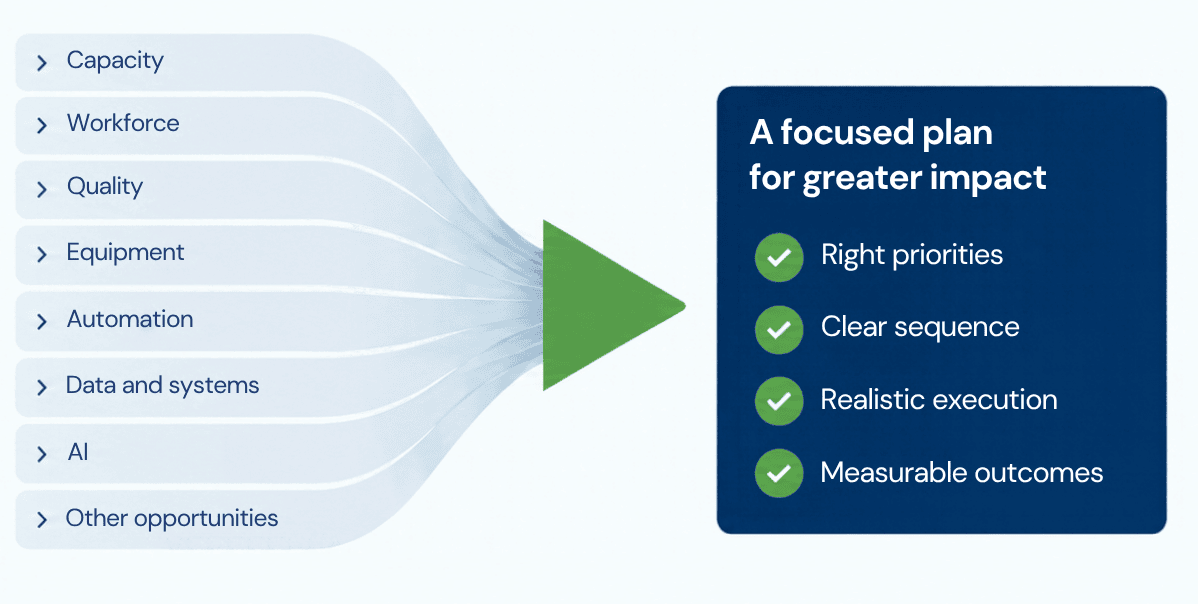
Manufacturers can identify many possible improvements: increase capacity, strengthen workforce capability, reduce quality risk, improve visibility, modernize equipment, automate a process, improve data or explore AI. 

The challenge is that resources are limited. People, capital, management attention and the organization’s capacity for change cannot support everything at once. 

Planning creates discipline around those choices. It helps leadership distinguish what is important from what is urgent, understand dependencies, consider readiness and risk, and determine the sequence that makes the most sense for the business. 

The objective is not to create more initiatives. It is to focus the organization on the initiatives most likely to improve performance and move the business forward. 

Manufacturing planning to prioritize initiatives, resources, and business improvements

When Planning Makes Sense 

When you know there is work to do — 
​but not what should come first. 

You have completed an assessment

You know the gaps and opportunities, but need to determine what to address first.

Too many initiatives are competing for attention

Leadership sees multiple opportunities, but cannot pursue everything at once.

A major investment is being considered

You need to understand where an investment fits within broader manufacturing priorities.

Growth is changing the operation

New products, customers or demand are creating decisions around capacity, equipment, workforce or capability.

Manufacturing Planning

A focused plan.

A clearer path forward.

what we plan

We look beyond the obvious answer. 

Manufacturing problems rarely arrive with the solution attached. 

A capacity problem may be a flow problem. A margin problem may be related to product or design complexity. A workforce problem may be a knowledge retention problem. A supplier problem may show up as assembly delays. An automation or AI opportunity may be part of the answer, but it should be evaluated against the manufacturing problem, expected value, readiness and alternatives. 


Our experience working across manufacturing operations, engineered products, industrial machinery, automation and workforce development has taught us to look for 1st, 2nd and 3rd order opportunities before deciding what should change. 

The result is a plan built around the business outcome, not around a technology category or a predetermined solution. 

CAPACITY 

The constraint was flow, not equipment. 
Factory flow and modular assembly improvements delivered: 

+15%
​inventory turns

+5%
margin

ENGINEERING + MARGIN 

The opportunity was hidden in design reuse. 

Making design asset reuse an explicit objective resulted in: 

+3%
margins

+30%
recovered design hours

-10%
SKU count 

WORKFORCE 

The problem was knowledge transfer. 

Mentorship between senior technical staff and apprentices resulted in:

-10%
training cost per hire

-25%
time to competence 

How We Build the Plan

The value is knowing what to do first. 

An assessment can reveal worthwhile opportunities. The difficult decision is determining which one deserves attention first. 
MTAB USA brings manufacturing experience to that decision. We look at the potential business impact, underlying constraints, prerequisites, the risks involved and the organization's ability to execute. 
Different stakeholders may have different priorities. The planning process creates a shared basis for deciding what matters most and what should happen first. 
Then we determine what should happen now, next, later — or not at all. 

Business Outcome


  • Capacity
  • Margin 
  • Workforce
  • Quality 
  • Responsiveness
  • Competitiveness 

Manufacturing Reality
​
​

  • Product 
  • Process 
  • People 
  • Equipment 
  • Suppliers 
  • Data 

Underlying Constraint

Identify the

root cause

Possible Intervention

  • Process
  • Equipment
  • Automation
  • Digital capability
  • AI
  • People

Value+Readiness+Risk

  • Business value
  • Readiness
  • Dependencies
  • Risk
  • Execution capacity

What Comes First

  • Now
  • Next
  • Later

Action

Priorities

Resources

Vendors

Execution support

What You Receive 

A plan leadership can act on. 

The output is designed to support decisions and execution, not simply document recommendations. The level of detail can be scaled to the size and complexity of the organization and the planning engagement. 

Prioritized Initiative Set
Sequenced plan
Value and risk view
Readiness and dependency view
Action definition
Success measures
Investment considerations
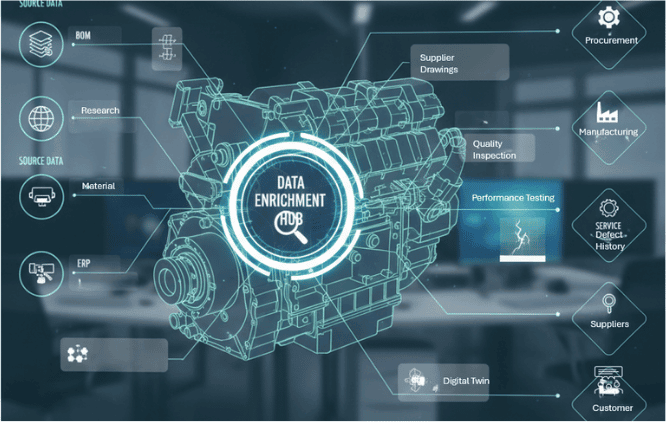
Manufacturing decision support for prioritizing investments and operational improvements

What the Plan Enables 

Focus action where it matters most.

Our experience has business outcome, the manufacturing reality, the underlying constraint, the options, the value and risk, and the organization's ability to execute.

CAPACITY 

Get more from the operation. 

+15%
​inventory turns

+5%
margin

MARGINS 

Improve the economics of manufacturing. 

+3%
margins

+30%
recovered design hours

-10%
SKU count 

WORKFORCE

Build the capability to execute

-10%
training cost per hire

-25%
time to competence 

How We Continue to Lead

A plan is only valuable when the organization can act on it.

We can stay involved at the level that makes sense for your organization.

Guide Implementation

Stay involved as an advisor to help keep implementation connected to the original manufacturing objectives, priorities and expected business outcomes.

Orchestrate the Right Partners

Translate manufacturing needs into clear requirements, support vendor selection and RFP development, and 
coordinate technology partners around the desired outcome. 

Provide fractional smart manufacturing leadership

Provide experienced manufacturing leadership when additional capability is needed to move priorities forward, build internal capability and maintain momentum without adding a full time executive.
Know what matters.
​Now decide what comes first.

From priorities to practical action.