Why Assess?
Before deciding what to change, understand what is really happening.
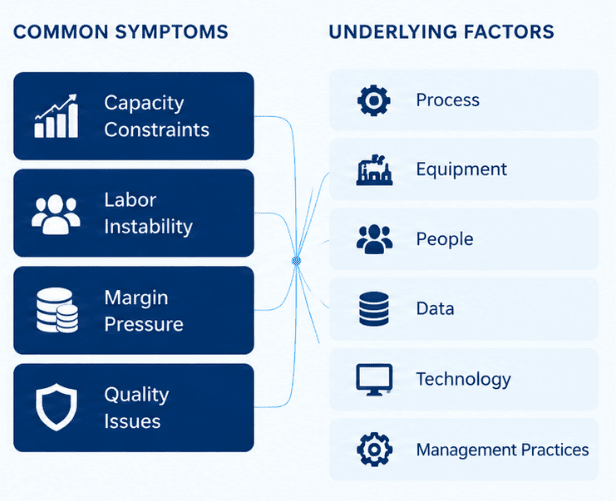
Manufacturers often know the symptom: demand is growing faster than capacity, labor is difficult to retain, margins are under pressure, quality is inconsistent, or teams are struggling to respond.
The harder question is what is causing the problem. Our SIRI assessment gives leadership an objective view of the operation so decisions are based on evidence rather than assumptions or the latest technology opportunity.
QUESTIONS THE ASSESSMENT HELPS ANSWER
- Where are we losing capacity?
- What is creating operational risk?
- Where are workforce capabilities limiting performance?
- Which process or equipment constraints matter most?
- Where are data or system gaps affecting decisions?
- Which technology gaps actually matter to the business?
Are manual processes limiting our technology potential?
- What should we address first?
- What should we not invest in yet?
When an Assessment Makes Sense
When the problem is clear — but the answer is not.
A Manufacturing Assessment can be valuable when leadership knows performance needs to improve but does not yet have enough clarity to determine where to focus.

Capacity is becoming a constraint
Demand is growing, equipment appears fully utilized, or throughput is not keeping pace. Does your organization have
invisible capacity losses?

Workforce instability is affecting operations
Skills gaps, staffing challenges or dependence on individual expertise are creating risk. Are you preparing your people
for the modernization you are planning?

Margins are under pressure
Productivity, utilization, quality, cost or investment decisions need closer examination. Are there manufacturing areas
that can unlock margin?

You are considering significant investment
Leadership wants an objective basis for deciding where capital should be deployed. Do you have a clear plan for how the capital investment ROI will be in your manufacturing metrics?

Automation or AI is being considered
There is interest in a technology opportunity, but the business case, readiness or application is not yet clear. What automation and AI tools are your people and floor ready for?

The operation has changed
Growth, new products, new customers, acquisitions or other changes have altered the manufacturing environment.
How flexible is your shopfloor for new products/ demand?

Different teams see different problems
Leadership, operations, engineering and IT have competing views of what should be addressed first. What business outcome drives alignment?
What We Assess
We assess the manufacturing operations holistically, not just the technology.
The assessment considers the factors that shape manufacturing performance and the relationships between them.

Business Priorities
Growth, capacity, margins, quality, workforce needs, competitiveness driving the
assessment.

Process
Production flow, process capability, bottlenecks, changeovers, operating practices affecting
performance.

People
Workforce capability, up- or re-skilling, new roles, knowledge dependency and organizational factors affecting execution.
performance.

Equipment and Facilities

Data & Systems

Technology
Current capabilities, gaps, readiness and opportunities where technology can address business need.

Manufacturing Performance
How We Assess
A structured assessment grounded in the real operation.
MTAB USA combines structured assessment with practical manufacturing experience. The work moves from understanding the current state to identifying what matters most and giving leadership a basis for action.
1
UNDERSTAND
Establish business priorities, operating context and current state.
2
ASSESS
Examine relevant manufacturing dimensions and identify constraints, risks, capability gaps and opportunities.
3
PRIORITIZE
Evaluate findings by business impact, urgency, feasibility, readiness and risk.
4
RECOMMEND
Translate findings into practical areas for action and clarify what should be addressed now, later or not at all.
FRAMEWORKS & TOOLS

SIRI Smart Industry Readiness Index
A structured way to assess manufacturing maturity and readiness across people, processes and technology. SIRI provides a benchmark reference point for understanding current capabilities and gaps.
Manufacturing Technology Balance Sheet
Connects manufacturing capabilities, gaps and technology risk to business priorities and investment decisions, providing an executive view of where manufacturing capability may require attention.
What You Receive
A clear picture of where you are — and where to focus next.
The assessment is designed to produce decision-ready outputs rather than a report that sits on a shelf.

Current State View
A concise view of the current manufacturing situation, including relevant capabilities, constraints, risks and opportunities.

Gap & Risk Profile
A structured view of important gaps and risks affecting manufacturing performance and readiness vs. your global industry benchmark.

Prioritized Opportunities
Manufacturing Technology Balance Sheet
An executive view connecting manufacturing capabilities, gaps and technology risk to business priorities and investment considerations.
Recommended Areas For Action
A concise view of the current manufacturing situation, including relevant capabilities, constraints, risks and opportunities.

Next Step Definition
A practical basis for deciding what should happen next, including potential initiatives that warrant deeper planning.
What the Assessment Enables
From assessment to better manufacturing decisions.
The value of the assessment is not the score or the report. It is the clarity it gives leadership to decide what deserves attention and what should happen next.
Focus Capital

Address Capacity
Identify constraints limiting throughput and where capacity may be recovered or created.
Strengthen Workforce Capability
Protect Margins
Focus attention on productivity, asset utilization, process performance and other factors affecting profitability.

Reduce Risk
Make operational, workforce, technology and investment risks more visible.
Determine What Comes Next
Use the assessment as the basis for a focused planning engagement or targeted action.
A CONNECTED PATHWAY
1
Assess
Understand the current state and identify what matters.
2
Plan
Determine what to do and in what order.
3
Lead
Provide additional support when the organization needs help moving priorities into action.
Provide additional support when the organization needs help moving priorities into action.
What the Assessment Enables
From assessment to better manufacturing decisions.
The value of the assessment is not the score or the report. It is the clarity it gives leadership to decide what deserves attention and what should happen next.
Focus Capital
Address Capacity
Identify constraints limiting throughput and where capacity may be recovered or created.
Strengthen Workforce Capability
Protect Margins
Focus attention on productivity, asset utilization, process performance and other factors affecting profitability.
Reduce Risk
Make operational, workforce, technology and investment risks more visible.
Determine What Comes Next
Use the assessment as the basis for a focused planning engagement or targeted action.