
Twin Ready Manufacturing- Preparing Processes, People, and Products
Digital twins are often dismissed as expensive, complex, and hard to sustain. That perception is not about the technology. It is about readiness. When processes are inconsistent, data is unreliable, and ownership is unclear, even a well-built twin becomes a one time experiment instead of a capability that improves decisions.
In my previous blog, I wrote about digital twins as a decision tool and why mid market manufacturers must stay use case driven within a 6 to 12 month window. This post addresses the question I hear most often from manufacturing leaders: How do we become twin ready without turning this into a multi year transformation program?
To make this practical, I will use a real situation from my earlier work. An automotive component manufacturer had an induction hardening bottleneck with manual processes, safety constraints, and prior automation disappointment. We used a digital twin to validate the automation design before deployment, selected a SCARA robot, and improved efficiency by more than 20 percent.
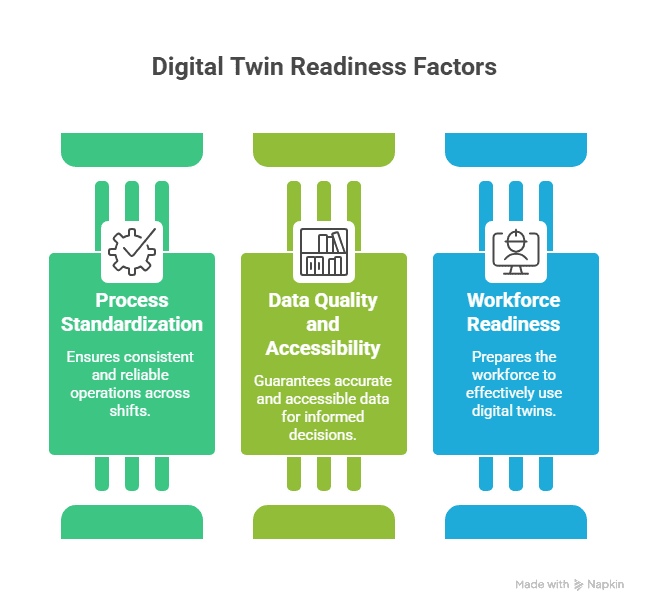
What “twin ready” means in manufacturing terms
Twin ready does not mean you bought a platform. It means your organization can keep a model aligned to reality, so the outputs are trusted enough to drive decisions.
I define twin readiness across three pillars. I will show each pillar through the induction hardening example.
Pillar 1- Process standardization
If the process is inconsistent, the twin becomes a one time engineering artifact.
Twin ready signals
Work is defined consistently across shifts
Downtime, changeovers, scrap, and rework are recorded the same way
Approval points for changes are clear during build and launch
In the Induction hardening example, the bottleneck was not only the machine. It was the variability created by manual handling and shift execution. Standardizing the load and unload sequence, exception handling, and hand-off rules was a prerequisite to trusting the predicted throughput.
Pillar 2- Data quality and accessibility
A twin needs good enough data that connects design intent to production behavior.
Twin ready signals
Consistent identifiers for part, revision, and operation
Actual cycle time and downtime reasons captured for the scoped process
Basic method to capture quality outcomes and causes
In the induction hardening example, We focused on a narrow data spine needed for the decision: cycle time, handling time, downtime patterns, safety constraints, and quality checks impacted by automation.
Pillar 3- Workforce readiness
A twin only creates value when production, manufacturing engineering, quality, and maintenance use it to answer practical questions.
Twin ready signals
Clear ownership for keeping the model current
Training focused on decisions, not dashboards
A pathway for operators and maintenance to challenge assumptions
In the induction hardening example, concerns about job skills, maintenance complexity, and prior failures surfaced constraints early. That input improved the design before money was spent on hardware.
Integration points and what to connect first
Manufacturers stall when they try to connect everything. Anchor integration to one decision, then connect only what improves that decision.
Design and engineering
Connect when the question is: Will this design and process work as expected
CAD geometry and interfaces
Critical characteristics and inspection requirements
Revision history that affects fit, cycle time, or quality
In our project, the part geometry and material informed the decisions for end effector, robot selection and pallet designs.
Manufacturing execution
Connect when the question is: How will this behave under real mix and schedule
Routing and work definitions
Actual cycle times and downtime causes
Exception handling
The model forced clarity on material flow, work steps, and exception handling, which then informed MES logic and operator routines.
Maintenance
Connect when the question is: Can we sustain performance and uptime
Asset hierarchy and critical spares
Failure patterns and mean time to repair
Preventive maintenance compliance for scoped equipment
The automation cell design was influenced by the maintenance team's input on why previous automation failed and what they needed to maintain to high production standards.
Common pitfalls when manufacturers start too early
Building a model before defining the decision it must improve
Expecting the twin to impose process discipline without standard work
Allowing revisions and routing to drift, making the twin obsolete
Over investing in integration before proving one measurable outcome
Chasing high fidelity instead of building credibility and adoption
Induction hardening lesson: The twin worked because it prevented physical rework by resolving constraints before deployment.
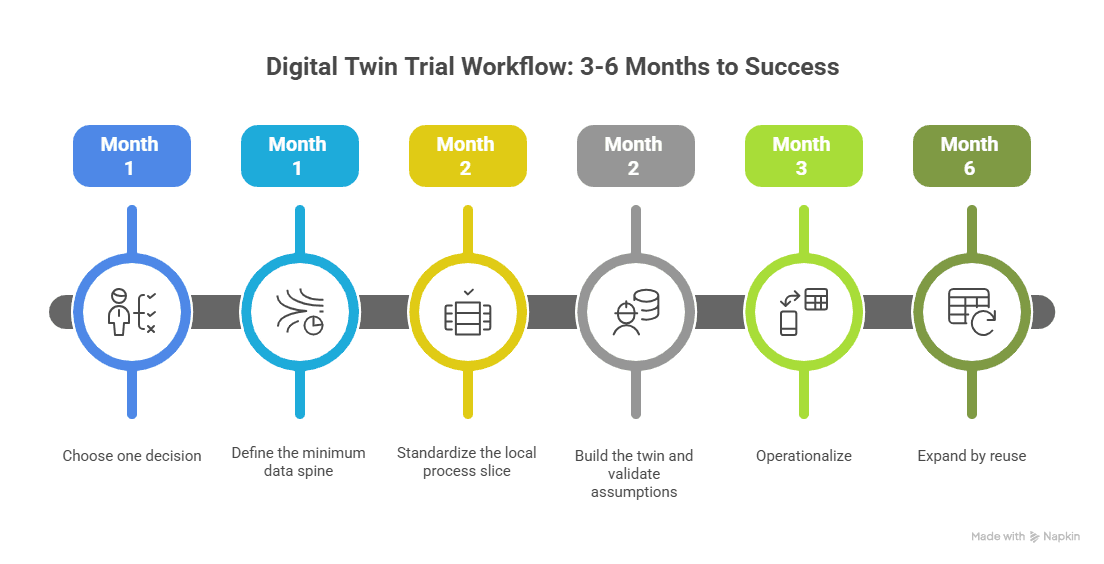
Workflow to trial a digital twin (3-6 months)
This workflow is designed to deliver one credible use case and build reusable foundations.
Step 1: Choose one decision
Pick one decision already costing time, margin, or customer confidence.
Examples:
Automation cell design and commissioning risk
NPI ramp stability for the first 8 to 12 weeks
Bottleneck capacity recovery without new equipment
Repeat warranty or service failure on a shipped platform
Step 2: Define the minimum data spine
Create a short list of data required for that decision:
Part and revision identification rule
Operation steps at the level needed for modeling
Cycle time, downtime, and quality outcomes for the scoped area
Step 3: Standardize the local process slice
Standardize only what touches the use case:
Work definition and exception rules
Cause codes that people will actually use
A clear rule for what changes require review
Step 4: Build the twin and validate assumptions
Build the simplest twin that answers the decision:
Simulation twin for layout, reach, interference, cycle time risk
Process twin for NPI ramp or staffing and WIP constraints
Performance twin for a bottleneck schedule and batching rules
Step 5: Operationalize
Weekly review with production, quality, and maintenance
One person accountable for data refresh and model updates
One leader accountable for acting on outputs
Step 6: Expand by reuse
Expand only after the first measurable win:
More variants of the same product family
More assets in the same line
One additional use case that reuses the same data spine
This mirrors your broader transformation principle of starting small, proving value, and scaling based on real impact.
Outcome metrics leaders will recognize and can measure
Choose metrics that both manufacturing and finance teams already track, and that a twin can influence within the scoped use case:
Capacity released on a constrained asset (hours per week or units per shift)
On time delivery for the scoped product family
WIP days or inventory days in the scoped flow
These map to operations reality and working capital impact, and they can usually be measured with existing ERP, MES, and basic production logs.
If you are considering digital twins, start with readiness, not software. I offer a Twin Ready Evaluation that identifies your best first use case, the minimum process and data spine required, and a 90 to 120 day execution plan tied to measurable outcomes. If you want to discuss your first twin use case, write to me.Related reading:Digital Twins for Competitive Advantage
Related reading:Leveraging Digital Twins for Efficient Automation